
It’s All Connected: Holistic Health and the Hidden Effects of Modern Life
Last updated May 2026

Mouthwash.
This seems to be my litmus test lately for finding my tribe—people who practice holistic health and wellness.
What does mouthwash have to do with overall health?
Exactly.
It’s all connected.
Mouthwash and erectile dysfunction
Conventional mouthwash kills the bacteria in your mouth indiscriminately—bad breath germs as well as the beneficial bacteria that produce nitric oxide.
Dubbed “Molecule of the Year” in 1992 by the prestigious Science journal, nitric oxide plays a central role in regulating blood vessel dilation. Low levels of this molecule have been implicated in a variety of medical issues from high blood pressure to diabetes to erectile dysfunction.
Mouthwash commercials promise fresh breath to make you attractive—but they neglect to mention the potential tradeoff in vascular health and sexual performance!
Here’s a tip: drink some green juice or eat parsley to freshen your breath without killing your nitric oxide-producing bacteria.
Finding the "tribe" in conventional systems
I was pleasantly surprised to find another member of the tribe—Dr. Pankaj Vij, who started a Lifestyle Medicine program at Kaiser Permanente in Northern California. The program is described as reversing diabetes and reducing the risk of heart disease through a whole foods plant-based diet, exercise, and mindfulness practices.
What stood out was not just the philosophy—but the setting. Kaiser is a large medical system where physicians are often allotted 10 to 15 minutes per patient.
Contrast that with a more typical experience.
A colleague’s tween-aged daughter became mysteriously ill—headaches, fever, nausea, exhaustion. The pediatrician ran labs and prescribed antibiotics, yet she wasn't getting better.
“Didn’t you just move into a new house?” I asked. “Could off-gassing from new carpet, draperies, or bedding be making her sick?”
It was.
It’s all connected.
Given the brief window of time the pediatrician had to spend with the patient, the doctor wouldn’t have been able to get a lifestyle history about the child.
In contrast, Dr. Sherry Sami, a holistic pediatric dentist and orthodontist in Southern California, has the freedom in her private practice to conduct a comprehensive intake—over 100 medical, dental, and lifestyle questions.
Holistic health is broader than the mind-body connection
Most people are on board now with the mind-body connection. Stress affects physiology. Chronic disease is linked to diet, lifestyle, and environment.
As for the mouthwash connection, people aren’t quite there yet.
The gut microbiome was just a blip on the scientific radar 20 years ago. It gained momentum after the Human Microbiome Project launched in 2007, entering mainstream awareness around 2010.
It makes sense that the microbiome would be connected to the gastrointestinal system, but it’s more of a stretch to consider that the microbes in your gut could affect your emotions, mood, and immunity, and be linked to diabetes, allergies, obesity, autism, and other medical issues.
Likewise, it’s hard to imagine that mouthwash could affect your blood pressure, erections, and risk of developing diabetes.
Immune system development begins at birth

We're not machines that can be compartmentalized.
We are holistic beings.
Beginning with birth—Cesarean sections (C-sections) have evolved from occasional life-saving interventions into common elective procedures of convenience that can accommodate doctors' schedules, increase hospital revenues, and help mothers maintain a tight, youthful body after childbirth.
At first glance, the outcome appears identical—a baby.
But research shows that babies delivered by C-section bypass the big dose of immunity-boosting bacteria in the birth canal. As a result, they are at greater risk of developing immune conditions such as allergies, asthma, and type I diabetes.
Similarly, formula-fed babies miss out on the immunity-building properties of breast milk.
Baby formula is a processed food. On paper, it appears to have all the appropriate nutrients. Yet focusing on specific nutrients doesn’t work as well as eating the whole food with synergistic components, such as immunity-building probiotics from Mom.
Gluten sensitivity—or something else?
Another example of the problem with thinking in isolation is the creation of genetically modified (GMO) crops engineered to withstand glyphosate, the main active ingredient in Monsanto's Roundup herbicide.
This makes farming much easier—just spray glyphosate all over and it kills all weeds and competing plants while leaving the GMO crops intact.
Efficient, yes.
But not without consequence.
Exposure to glyphosate has been associated with cancer and other health problems in agricultural communities, as well as in consumers who believe they're gluten intolerant. For years, chemical manufacturers studied it in isolation and declared it safe.
Yet more recent research suggests that the so-called “inert” ingredients, or their interaction with glyphosate, make it significantly more toxic.
Glyphosate works by disrupting the shikimate pathway—a biological pathway found in plants and bacteria, not human cells. That was one of the main reasons it was long considered safe.
Monsanto also patented it as an antibacterial and antimicrobial, so the idea that it might also kill bacteria in the human gut should not be surprising.
What scientists didn't fully understand until more recently is that this same pathway exists in many bacteria in the human gut.
For some people, what looks like wheat sensitivity may actually be a toxic reaction to glyphosate or other chemicals rather than the wheat itself.
For others, modern wheat may be part of the problem—it's been selectively bred for higher yields and baking performance, resulting in higher concentrations of gluten.
Industrial agriculture and its ripple effects
Industrial agriculture emerged after WWII when chemicals originally developed for warfare were repurposed as fertilizers and pesticides.
These chemicals made it possible to grow massive amounts of cheap commodity crops quickly and at an industrial scale.
Efficient, yes.
But not without consequence.
Disposing of the military industry's chemicals and flooding Big Ag's coffers came at the expense of:
- nutrient-depleted soil
- polluted water systems
- loss of wildlife biodiversity
- antibiotic resistance
- processed foods that disrupt the human microbiome and drive chronic illness
Big Ag claims that industrialization is highly efficient and necessary in order to feed a growing population. Yet food scarcity is often less about production than distribution and access.
In fact, the surplus of monocrops like corn and soy has incentivized food conglomerates to unload the excess by engineering and selling more processed food products.
Factory farming and human health
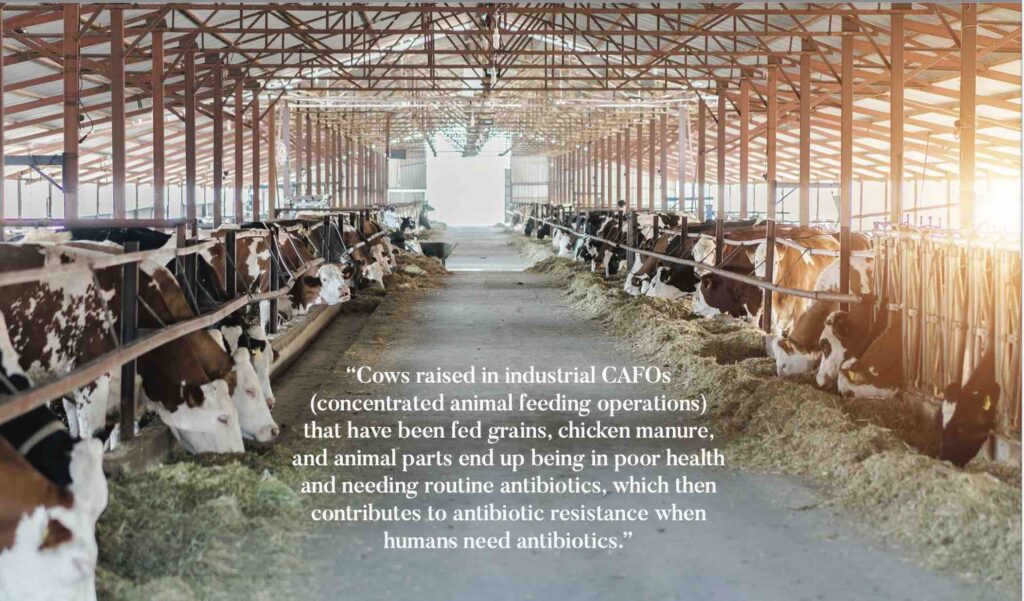
In concentrated animal feeding operations (CAFOs), cows are fed grains, which their digestive systems aren’t designed to handle, whether the grains are organic or not. Cows’ stomachs are designed for eating grass.
On top of that, the FDA allows factory farms to supplement cattle feed with chicken manure, pig or horse parts, and even cow parts.
Yes, feeding meat to herbivores is legal!
This leads to chronically unhealthy livestock needing routine antibiotics—which then contributes to antibiotic resistance when humans need them.
Contrast this with regenerative farming models like those of Joel Salatin’s Polyface farm.
A self-described “land healer,” Salatin gained national recognition after being featured in Michael Pollan’s book The Omnivore’s Dilemma and the movie Food, Inc.
In Polyface’s self-contained ecosystem, the herbivore cows eat their natural diet of grass and are moved to new pasture daily so the grass gets a rest and can continue to grow. The egg-laying hens follow the cows in the pasture rotation to eat bugs and scratch through the cow dung for maggots.
In the winter, the cows are fed hay in a shed, where they lounge on a bed of wood chips, sawdust, and hay to absorb their excrement. After the cows are done, corn is added to the fermenting compost and the pigs are brought in to root around for corn, aerating the compost in the process, creating a rich, natural fertilizer.
In Salatin’s regenerative ecosystem, nothing—animal feed, fertilizers, antibiotics, or manure—needs to be trucked in or out.
The parallel: soil health and human health

Industrial agriculture depletes nutrients in the soil, disrupts the soil microbiome, and temporarily adds nutrients back in the form of chemical fertilizers—and with the plants’ immunity weakened, requires chemical pesticides.
Processed food does the same within the human body.
Factory-farmed and processed food depletes nutrients in our bodies, kills the microbiome in our gut, and with our bodies’ immunity weakened, chronic illnesses often develop, for which pharmaceuticals are prescribed to manage symptoms.
Isn’t it interesting that some multinational conglomerates profit from a cradle-to-grave portfolio that includes industrialized agriculture, processed food, and pharmaceuticals?
It’s all connected
The next time you’re presented with a choice that seems innocuous—or even beneficial—remember that it’s all connected.
Mouthwash to kill bad breath germs?
Organic baby formula?
Cheap factory-farmed or processed food?
It’s all connected.
How do you freshen your breath?
Editorial Note
Originally published in MegaZEN (Vol. 7, 2020), a health and wellness journal founded by Dr. Sherry Sami and Dr. Habib Sadeghi. The publication no longer exists.
This article was written prior to some of the more recent findings on Roundup’s toxicity, including the role of so-called “inert” ingredients. I came across this while researching Nature's Palette.
On June 24, 2020, Monsanto's parent company, Bayer, announced it would pay up to $10.9 billion to settle approximately 125,000 Roundup-related cases.