
A Health Coach to Help You Feel Better in Your Body
Most modern health problems aren’t a mystery. They’re shaped by how we live—what we eat, how we sleep, how much we move, and how stressed we are.
I work with people who have complex, often chronic health issues and are tired of being told to optimize, biohack, or “just try harder.” Together, we figure out what’s not working and make changes that fit your life—and stick.
Food matters. Sleep matters. Stress matters. Movement matters. None of them work in isolation.
The goal isn’t perfection. It’s about feeling better so you can enjoy your life more.
It started with food
Pasta & pastry starchatarian
In my 20s, I was a vegetarian who didn’t eat many vegetables.
For ethical and environmental reasons, I avoided meat—but my diet was mostly pasta, bread, pastries, and vegan fake meat. Even with a Stanford degree in human biology and a job at a medical school, I assumed that way of eating was enough to keep me healthy. I was young, and it was the height of the low-fat era—when cutting fat usually meant eating more carbs.
I thought I was eating responsibly.
Immersed in food culture
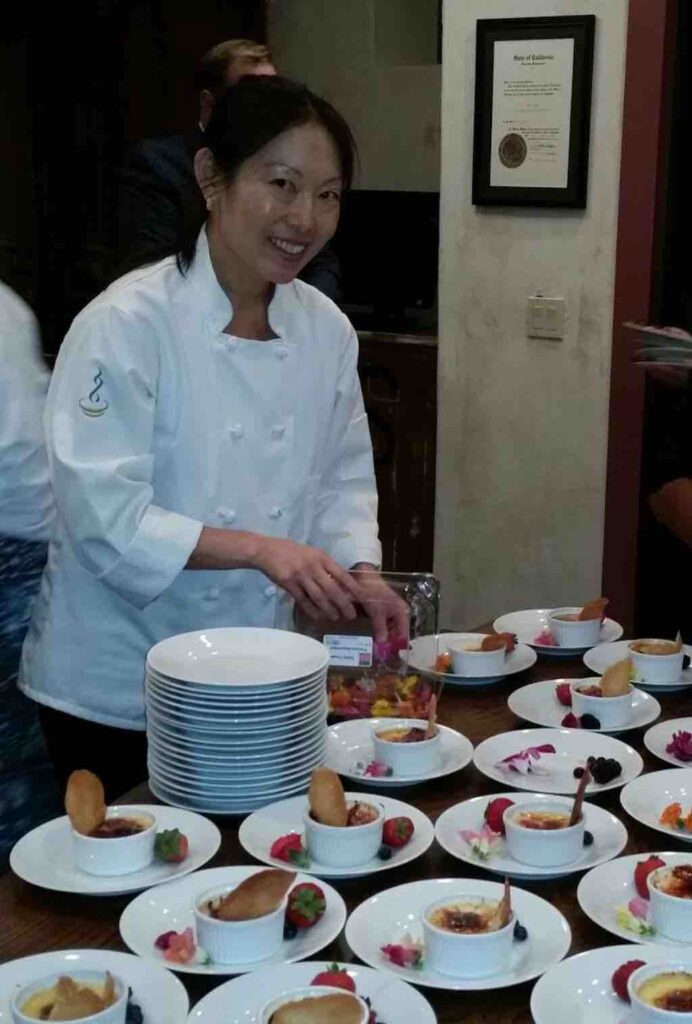
In my 30s, I worked on the entertainment side of the culinary industry: as a food writer, cooking teacher, and at a culinary school where I shaped curriculum and curated the celebrity chef lineup.
My freelance writing and my work at the culinary school were closely intertwined—I would invite a food artisan I’d profiled to teach or write about a chef after they appeared at the school. I also explored food as culture, from regional Mexican cuisine to Persian New Year meal traditions.
In the professional kitchens and culinary circles I moved in, cooking from scratch was the norm. Processed food wasn’t. I ate extremely well and got spoiled in the best possible way.
Looking beyond the plate
In my 40s, working in large-scale food systems, including Stanford Dining and a healthy food service for Google, shifted my perspective on industrial food and farming.
By the time I became a certified health coach and lifestyle medicine educator, I had stopped making pasta and desserts regularly and had given away most of my baking equipment. I wasn’t eating less food—I was eating fewer refined carbs.
I also prioritized sleep.
My blood pressure and triglycerides dropped, and the development of a genetic condition has been avoided so far.
More than food
Earlier in my life, I was a professional dancer. That background continues to influence how I think about movement—not just as calorie-burning exercise, but as posture, awareness, and mobility in everyday life. It also led me to pay attention to the connective tissue that holds everything together.
As my work evolved, my focus expanded beyond food to include sleep and stress more directly. I teach various forms of meditation as a practical tool for regulating the nervous system. A dozen types are included in my book on meditation.
In recent years, I’ve been geeking out on fascia and quantum biology—specifically sunlight. When these areas are overlooked, it can help explain why people can still feel unwell even after they’ve addressed the usual basics—food, exercise, sleep, and stress.
Food is still central to my work. It’s just part of a larger system now.
An integrated practice
I emphasize real food and traditional lifestyle practices, without rigid rules or trendy extremes.
Because food and health are inseparable from culture, I draw on my background as an English (ESL) trainer, along with a love of international travel and languages. This allows me to tailor my work to clients from different cultures, including those with varying levels of English proficiency.
If this approach resonates, the next step is a brief conversation to see whether it’s a good fit.